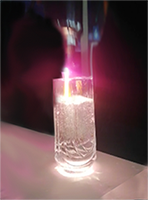
The science, engineering, and real-world applications of hydrogen plasma conversion technology for sustainable heating systems.
What is Hydrogen Plasma?
Plasma is the fourth state of matter — beyond solid, liquid and gas. When energy is applied to a gas with sufficient intensity, its molecules break apart and the resulting high-energy state is called plasma.
Hydrogen plasma is specifically created by breaking water molecules (H₂O) apart under extreme energy conditions, releasing hydrogen in its most energetic form.
This is the product of hydrogen plasma technology — hydrogen in a supercharged plasma state: unstable, intensely energetic, and ready to release enormous heat the moment it is combusted.
Think of ordinary hydrogen gas as a candle. Hydrogen plasma is the surface of the sun — same hydrogen atom, completely different energy state. (The analogy is not just poetic - it is perfectly accurate, if you like to know more click Stars Energy State)

How is it Created in a Lotus Combi Boiler?
The Lotus Hydrogen Plasma Combi Boiler does not use any external fuel. It uses only the water already inside the boiler. Through a patented electrical process, the boiler converts water directly into hydrogen plasma on demand — inside the boiler itself, at temperatures reaching 2,500°C.
The hydrogen plasma combusts instantly in a controlled environment, releasing powerful heat energy. The only byproduct is water vapor, which condenses back into water inside the closed system. This means the boiler consumes only 1–2 litres of water per year — approximately half a glass per month.
No gas storage. No fuel supply. No carbon emissions.
Why is This Different from Electrolysis?
Conventional water-splitting technology uses electrolysis, which separates water into hydrogen and oxygen gases through an electrical current. Its efficiency has never exceeded 70% worldwide — meaning a significant portion of input energy is wasted before any heating takes place.
The Lotus plasma process works differently. By converting water directly into plasma — bypassing the gas stage entirely — the system achieves a Coefficient of Performance (COP) of approximately 2.0, meaning it delivers twice the thermal energy relative to its electrical input.
In year-round real-world applications in Germany and Austria, seasonal COP (SCOP) values of 2.5 have been recorded — 250% energy efficiency compared to natural gas boilers.
📊 In numbers: Electrolysis ≤ 70% efficiency. Lotus Hydrogen Plasma: COP 2.0–2.5 (200–250% efficiency). The difference is not incremental — it is a fundamental shift in how water energy is accessed.
How Does it Compare to Hydrogen-Ready Boilers?
Most hydrogen boilers and hydrogen-ready boilers being promoted across Europe today still depend on hydrogen gas supplied through pipelines or stored in tanks. Hydrogen-ready boilers are designed to switch from natural gas to hydrogen when — and if — the local gas grid infrastructure eventually supports it. They do not generate their own hydrogen. They remain dependent on external supply chains, storage infrastructure, and energy markets.
The Lotus system is categorically different. It produces hydrogen plasma directly from water, on demand, inside the boiler itself. There is no gas grid dependency, no hydrogen storage, no waiting for infrastructure that may take decades to arrive. A Lotus boiler installed today is already fully independent — not hydrogen-ready, but hydrogen-operating.
Why Does it Matter for Heating & Hot Water?
The practical implications are significant for any building — residential, commercial or industrial: The boiler raises water temperature from 15°C to 90°C in under 10 minutes, then shuts itself off automatically and enters standby until the temperature drops again. In practice, it operates only about 5 hours per day to meet all heating and hot water needs.
It works with equal efficiency at −50°C or +50°C outdoor temperature — unlike heat pumps, which lose efficiency in cold climates and can fail entirely below −10°C.
It requires no gas pipeline, no hydrogen storage infrastructure, and no fuel delivery. A building in a remote mountain location is just as easy to heat as one in a city centre.
When integrated with solar panels, wind turbines or geothermal energy, the system achieves zero operating cost and zero carbon footprint — a genuinely closed-loop sustainable heating solution.
A Proven Technology — Not a Concept
The Lotus Hydrogen Plasma Combi Boiler was patented over 20 years ago and has been in active commercial use for more than 15 years, exported to Germany, Austria, the Netherlands, USA, Canada and several Asian countries. Its performance has been independently measured and certified by accredited institutions. The relevant test reports can be viewed on the Documents page.
This is not a laboratory experiment. It is a working heating system, installed in villas, student campuses, greenhouses and factories — heating real buildings, for real people, right now!
While the hydrogen boiler market grows and hydrogen-ready boiler standards are still being defined across Europe, Lotus has already been delivering fully operational, zero-carbon hydrogen plasma heating for over a decade.
Check our products list and datasheets, more detailled information, and installation examples.
Visit Lotus-Hydrogen-Energy.com →